Episode Transcript
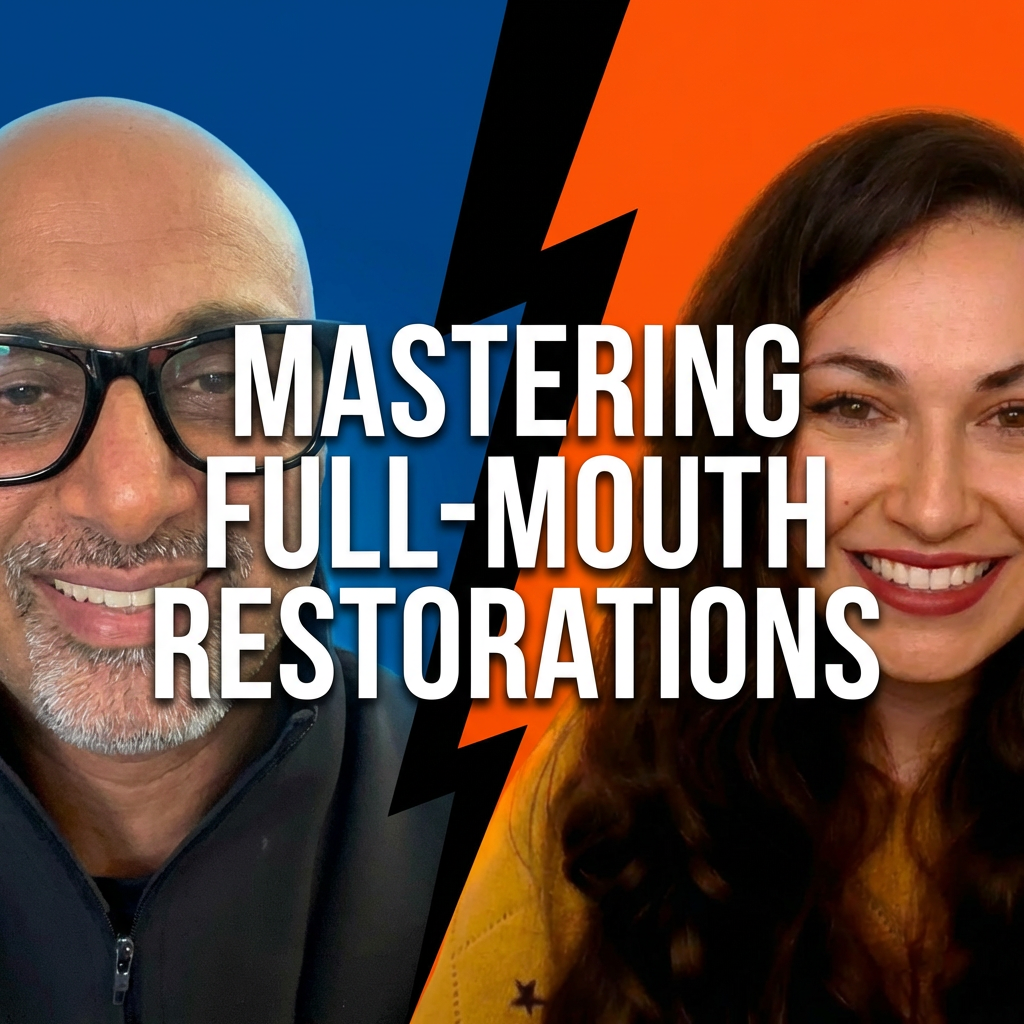
[00:00:00] Speaker A: Do you wanna do more cosmetic cases and full mouth cases in your practice, but you run into, how do I do them? My patients can't afford them. How do I stage this? Then you need to really pay attention to today's episode, and you need to get to the 3D summit to hear today's episode. Guest Dr. Diana Tadros. Diana, how are you doing?
[00:00:21] Speaker B: I'm doing amazing. Thank you for having me. How have you been?
[00:00:25] Speaker A: I've been wonderful. I don't get to live in sunny Florida like you do this time of year, but I'm not jealous of you
[00:00:31] Speaker B: in the summertime year round. One season, year round.
[00:00:34] Speaker A: No, no. You have beautiful and then you have hot as shit.
[00:00:37] Speaker B: Yes. Which you guys will get to experience at the summit.
[00:00:40] Speaker A: That's correct. Yeah, absolutely. Well, I've known Diana from afar for many years and then finally got to meet her for the second or third time at a recent event in California. And I knew right then and there that we had to have Diana as part of the summit. She has an amazing skill set, does amazing work. If you're not following her Beauty and the teeth on Instagra, you're missing out.
[00:01:06] Speaker B: Thank you.
[00:01:06] Speaker A: Diana, tell us, tell me this, okay?
Why, why are more dentists, why are dentists afraid to get into full mouth restorations or why do they hesitate to do more of them?
[00:01:19] Speaker B: So I think, you know, with high, high, high risk comes high reward, right. And these kind of cases, they can go sideways fast. If you don't have, like the proper training or maybe hand holding on, how do we even know who is a full mouth case? Right. How do you even set this case up? How do you even diagnose it? So I think a lot of it is just diagnosing it properly and then trying to treat it. So you're not, you know, single tooth dentistry. We're taught single tooth dentistry in dental school, but I would say that dental school makes us barely not dangerous. Right. When we come out into the real world is something that requires a little bit more skill set and a little bit more training past dental school to tackle all the teeth at once and to set them up properly.
The other thing is just people will say, well, you know, my. I live in a demographic where my patients can't afford that kind of treatment. And I think that's kind of where 3D printing changed the game for this type of modality to have in your office. So whereas before, you know, you would say, well, it's all or none, $60,000 or nothing to do this and that's out of reach for, I would say, 95% of, you know, citizens in America. Like, that is not a financially feasible number to start off the gate.
So now when you have an option where you can start to stage them, this becomes, makes it for you as a clinician more manageable on the clinical end, but for the patient more manageable on the financial end to kind of get this kind of case type going.
[00:02:45] Speaker A: So let's, let's kind of break this down for our listeners. Okay, so let's back up for a second.
I love what you're talking about. So there's, to me, there's two types of patients, patients that can afford to do it all at once, and we just need to figure out how to do it all at once. And then patients who can't afford to do it all at once. And now we have a new tool in our tool belt to stage these cases out. But the process is essentially the same, correct?
[00:03:11] Speaker B: The process is the same. The consultation is the same. I don't look at one patient that I know that can afford it one way versus the other, regardless. And I'll tell you, in my practice, we don't do both arches at the same time anyways. Even if the patient were to pay everything up front, we're not doing both arches at the same time. We're going to temporize the lower with 3D prints, and we will finish off the uppers on the ceramics, and then we will now take, move on to the lowers, take off the overlays, whatnot, and then start segmenting the lower. So there's, there's no. On my end. We're not doing it now. In a lot of practices, they do them both together. But to me, like, I'm more of a, like, step by step. Let me, let me get the uppers exactly where I want them. I can adjust the lower temps now based off my final upper ceramics, and then we can move on to the lowers. But the diagnosis, consultation, appointment is the exact same. You know, all of that is worked up the exact same way. The only thing that we're changing here is the timeframe when we get into it.
[00:04:04] Speaker A: All right, so you're the expert at this, so correct me if I'm wrong. So I want to walk people through this story. Okay? I'm going to ask you to talk briefly about your consultation process.
Number two, the, the wax up, or I think you call it the DAX up is what you guys call it. Then we have the delivery of the care part of it. Then that's the Preparation, then that's the ceramics, then it's delivery. Okay, So I think for today's conversation, to give everybody a preview, let's focus on your consultation process and the DAX UP process for this. So let's start with a consultation. What makes you successful? How are you leveraging technology? What. What is. If I come into your office for this, what. What does that process look like?
[00:04:44] Speaker B: So the process starts with my receptionist. You know, whenever we have a patient that calls, I'm big on the entire team knowing what you do with your technology, because my receptionist knows what we're doing because she's. And she's the first one that gets to talk about it. So when the patient calls the office and says, you know, my teeth are breaking, or I'm interested in veneers, usually they're calling saying they want veneers, but they end up turning into something more. Right. And she'll say, you call the right office. We have the highest level of technology here, and we'll get to show you what this looks like before you get going. So the patient already is coming in with this expectation that, wow, like, I'm going to get kind of like a try before I buy kind of thing. Or there's a lot of planning that goes into my. My process. So. And we're big on that at the consultation. I say it over and over in many different ways. Listen, the way we do this in our office, we're going to set this case up digitally. We're going to look at it together. If I can try this in the mouth, we will, you know, now when we're getting into patients where we have to open the bite, I. And we'll. I kind of will show how we do this at the summit. But the biggest challenge I think doctors have is, okay, I know I need to open the bite, but what arch do I use to open the bite? Do I use the upper? Do I use the lower? Do I use with. How do I know?
So, you know, the. I'll kind of showcase the how we do this in our practice. To do it really we're doing it is with 3D printing. I will simulate what this would look like if I did it with just the uppers, just the lowers. I could try that in or both. You know, a lot of it is, you know, what looks good in the face. We're coming back to what looks good in the face and what feels right. But at the consultation appointment, we just kind of go over the process of planning this. Now, I do not plan this alone. They will See their digital design before prep day, 100%. If I can do it. If I can try it in the mouth. We're trying it in the mouth for prep day. I don't want to be the dentist anymore that preps a full arch and puts a temp in the mouth. And the patient has never seen what it would look like. Like, I don't want that surprise. You know, you had a long day prepping all day long. The worst feeling in the world is putting in a design at the end of that appointment and the patient being like, oh, I didn't, I didn't know it was going to look like this. Or, oh, heck, oh, these are palm. No, we want to iron all that out before prep day so that if there's something you don't like. And I always tell them my first design is my best guess, I say best guess at a consultation appointment a lot. Because if they're coming in with old crowns, old dentistry, old bondings, I don't know how thick those crowns are. I don't know what the path of insertion is on those crowns. I don't. I can't really truly design you until I take all this old dentistry off and get a scan of what's underneath and then I can refine it. So I tell them we are going to go through a variation of prototypes. Maybe it's going to be two, maybe it's going to be three. But we are not moving forward to the ceramics until we love the prototypes. And so we spend a lot of time in the consultation appointment just assuring the patient, like, you came to the right place, like, we are going to set this up for you and we're not moving. We're not going to be like, trust me, your. Your finals will look better than your temps. No, like, we. We spend time in the temps and we spent time at the consultation appointment telling them, you know, the provisionals are going to look better than what some finals look like. You know, And I make it a point. Even in our consultation appointment, we have a TV monitor in our operatory. And some of the before and afters, they're not even the ceramics, they're the temps. It's a before photo and then the temps. And they don't even know that until I say, oh, some of these pictures are actually temps. They're not. They're not actually ceramics. To give them this assurance, like, every step of the way is going to be done at the highest quality.
[00:08:12] Speaker A: Let me ask you this. In your consultation, do you whip out exocad or Almost never. Do you do that?
[00:08:18] Speaker B: Do not. I do not. Now I don't need to whip out Exocad anymore because there's enough documentation around our office that showcases that we're using it. One of them is the video that we have in the waiting room. The other thing is the patients get this nice like magazine from us at a consultation appointment. It's a really like, well, high quality book and it goes through every single step by step process of how we do our smile makeover. And two of the pages are dedicated to the smile design part of how we use the software. Exocad comes into play when they come back the next appointment. Whether if it's a patient that I can try in the design, we go to the consultation room first. I show them their design on Exocad and then we move to the operatory to try in the printed mock up.
If it's a patient that is not a candidate for printed mockup. So you're talking about people who have big bulky crowns, maybe facially placed teeth, rotated teeth. They don't make for a good printed mock up and oftentimes they don't even make for a good BISC Pro try in. We're just going to focus on honing in on the digital what we're looking at digitally and they understand I can't give them a full feeling of what this looks like in the mouth until we get all the old dentistry off. But Exocad comes into play the second appointment. The reason Exocad comes into play the second appointment is actually financially. And I'll tell you why I used to do this. I used to spend all my time at the first appointment, consultation appointment and wasting time spinning gears showing them all these things I can do. They leave and then the money is just not even an option. You know, financially they, they were, it was off the mark of what they thought. So, you know, now at the consultation I mentioned our fees. I say it, I say it, I don't like my receptionist. Say it. I tell them what we are per tooth. If the patient is like, you know, that's what I figured or how can I make this work? Then I'm like, all right, deposit. The deposit kickstarts me actually spending my time doing a full mouth design in Exocad. And then I don't mind spending all the time in the world, you know, taking my time fine tuning that, bringing them back in. Most of these full mouth cases, you're going to have to see them back in anyways because you have to deliver them the deprogrammer so we are going to be seeing them back regardless before we get going on this case. So I make it a point at the deprogrammer delivery appointment that gets bundled in with the design review appointment.
[00:10:28] Speaker A: So, okay, all right, so I love that sound business advice right there. Do the consultation, get the patient, you know, get the patient semi qualified or qualified, then do a little bit of work and then go, then go all in with them. Okay, so, okay, so here's what's happened now, Diana. I've come in for the consultation. I liked you, I trusted you. I came in. Now I'm gonna come back and you're gonna show me the digital design. My mouth happens to be something that you could show me what it looks like. Are you going to just randomly open my vertical or are you going to do a deprogrammer on me to determine the vertical for this next step?
[00:11:07] Speaker B: Yeah, so that's a great question. So at the consultation appointment, we scan two bites for anybody who has a occlusal, you know, discrepancy that we know. We're going to open the vertical, we scan them in mip, and then at the end of that consultation, at the end of the consultation, when they are going to move forward with the treatment or they, we believe that they are some way bought into this, we will scan them with a printed leaf gauge at a vertical. We're going to start. Two millimeters is our standard number. You can, you can put a leaf gauge in at 2 millimeters and that'll give you enough space to create a deprogrammer. I do not rely on my software to digitally open my bite anymore. It's not as accurate. And then I will tell them, listen, when you return, I want to try this design in at your new vertical. But I'm also going to give you the appliances going to help get us there. Okay. So I don't put the appliance as the forefront of this treatment plan because patients, when they're coming in wanting veneers, they're not excited that you're going to give them a piece of plastic at
[00:12:02] Speaker A: the next fits over the roof of their mouth.
[00:12:04] Speaker B: Yeah, they're like, you know, pass. So I try to make that kind of just like this is just a little temporary thing. We want to see how this feels for two weeks. So even when they come back, I don't hand them to deprogrammer right away. The deprogrammer is the last thing they get. At that appointment, that appointment, that second appointment, the treatment plan review, we go over the digital design.
If T bone, I could try it in. We take them to the operatory. Mike, let's see what this looks like in your face. Let's put the design in. Now that design has the built in new vertical. So because I scan them with an open bite and they're like, you know, instantly it's like, oh, my goodness. Like, wow, this is great. I'm like, great. So we did open the bite here, but we want to make sure that's comfortable for you before we take it to the next step. So here is this appliance, just going to wear it for two weeks and most people will come back and say it actually feels really nice. Right. We always like to use the phrase, it's an instant facelift in South Florida. If people aren't heading to the coffin, they're heading under the knife. So we do cater to that kind of demographic. They love anything that can enhance the face, the lips, you know, the structure. And it does help actually lift the face, you know, smooth out the wrinkles around the lips, et cetera. So we kind of tied into that. But yeah. So the second appointment is actually, I would say, probably the most exciting appointment for me because this is kind of where everything comes together and we already know that we're going to have a relationship with this patient. Now the second appointment also will be a huge indicator for you as a dentist on, how do I say this professionally? Like, how crazy is this patient?
[00:13:29] Speaker A: Yeah.
[00:13:30] Speaker B: And this is where I start to realize how difficult the patient is going to be. Because if I put a design in and they start tearing it apart and da, da, da, I start to kind of my, my, my little, you know, spidey senses start going up like, okay, this is going to be a little bit challenging if I get a patient like that who is just, you know, picky, picky, picky, I'm going to give it one more appointment like this, I'm going to do another design, try in with them, and if we're still like, you know, it just unreal expectations, or then I start to maybe try to reel out of this case. All right? And that sounds silly, but notoriously, all the cases where we've had a patient like that on the front end, they have turned out to be the biggest nightmare all the way through the process, if you even get to finish the process with them. So this is a great way for dentists before you actually really touch a patient and prep them and become married to the case to see kind of what you're up against when it comes to even personality wise of the patient.
[00:14:27] Speaker A: I look at this as a test drive for both parties. It's a test drive for the, for the patient and a test drive for the practice. Because there's no, there's no patient that's worth the stomach lining of somebody that's going to drive you nuts that you can't make happy. You know, you just gotta, you gotta avoid the crazy women.
[00:14:45] Speaker B: Right, right, right.
A hundred percent. And I think that's kind of the, I think that's the struggle that, you know, some young adults do is they don't feel like they have the ability to say no to any case. Right. They have to take any case that comes in the door. Maybe it's a limitation by whatever practice they're at, or maybe they just feel pressured. The biggest win you can get in dentistry is just learning to say no sometimes.
[00:15:07] Speaker A: All right, so now let's lastly talk a little about, I don't want to say about Exocad, that happens to be the software we both use. But let's talk about the digital wax up. When did you, did you ever do it analog? And when did you move from analog to digital?
[00:15:23] Speaker B: Yeah, so I did do it analog.
The analog I was mainly doing it for was actually for composite cases. So I would actually simulate, you know, what I was going to do with composite buildups if I was going to composite veneers with composite on a stone cast. And I moved to digital when I started going through the accreditation process, when I was trying to finish it. And the reason being is all the wax ups I was getting back from, my labs would not pass accreditation, the design would not pass accreditation. And for those who do or don't know, the accreditation process through academic hospital dentistry is hard. Right. And there's so many nuances to what they're looking for in an ideal smile. But a lot of labs, your local labs, not going to nail it. You know, your, your very few ceramics know what the parameters are. And my labs were always doing, you know, stone wax up. And I was like, well, I'm not going to wax up a whole buckle occlusal lingual in wax. That's not what I wanted to do. But once I saw my lab turn digital, I was like, well, wait a minute. Like, I mean, I know how to use a computer. Like, maybe I should just try this software too. And at the time, the lab that I worked with was like, well, I don't think Dennis can get this software now. This was back in 2019.
They're like this is a lab software. And at the time, Exocad, when you called them up in America, like, they were such a small company. You'd get the VP on the phone, which was Mark Rosenberg, and I was like, hey, you know, like, I'm. I want to buy this software. And he's like, what lab are you with? I was like, well, I'm a dentist. And he's like, what do you want to do with this software? And so I think that you people like me, and you kind of opened the door for them to get this software in the hands of clinical dentists. So that was kind of what. Where I was at, and it kind of was maybe a blessing that I had finished Kois around the same time and finished accreditation. So I was able to actually do a good design in the software that would rival what my ceramics was doing.
[00:17:14] Speaker A: That's awesome. Okay, so what do you say to the dentist that's like, well, I don't have time to learn all this. Like, who's got the time? Like, that seems complicated. What do you say to that dentist that's just fearful of taking that step of moving into digital design?
[00:17:30] Speaker B: My thing is, if you don't have the time to do it, the dentist across the street will.
And it's getting. You know, I used to think even just having a scanner in your office was, like, a big wow factor, but now Most patients in 2026 have been scanned in another office.
And it's not that designing is.
It's an investment.
And I just only want to say it's an investment. But the ROI that you get on the patient experience, that you get on the predictability and dentistry, on the efficiency of your workflow, it's.
[00:17:58] Speaker A: It's.
[00:17:58] Speaker B: I don't even think you can measure it financially. It's just. For me, it's a stress reliever. You know, it takes. Of course, it has a learning curve. So does anything.
When you first started prepping teeth in dental school, it took time to learn it, but it's very.
Maybe a little bit difficult to learn, but it's a little bit easier to master. You know, it's kind of like snowboarding. But I just. I think if. If you're not starting it, someone around the corner is going to start it, and you don't want to be. You don't want to be left behind. I don't think, you know, AI or is going to replace dentists or digital is going to replace dentists, But I do think dentists that do digital dentistry will replace dentists who don't I love
[00:18:35] Speaker A: the directness of your answer because if you don't do it, somebody else will.
And that's really kind of where dentistry's at. You know, with people being able to go on social media with everything. At the end of the day, you're pro, you're probably not, and we don't have to dive into this, but my guess is 80% of your patients, you're not their only consult or their first consult, you know, on this dentistry. And so really, it's, it's really about standing out and really making that trust. And honestly, if you don't do it, somebody else will.
And the other thing that I want to impress upon people about any type of technology, technology opens the doors to creating a new process. And when you create a new process, you start doing more of it. Like, I bet you since you put Exocad into your office, you've done more cases because you've learned a new skill. It's created predictability, it's created a path forward.
It's honestly, it's a no brainer for every office. Like, I know I don't know this for a fact, but I'm pretty confident Exocad sells more licenses to dentists than labs at this point in time. Or it's pretty close, if not for our listeners. If you want to learn more about Exocad, you can reach out to me at 3Dtech. We're authorized distributors of Exocad, so. But either way, you know, we want people to learn the software and use the software. Not to be fancy or not to be fun, but to actually do dentistry and to, and to enhance your practice.
[00:19:57] Speaker B: Yes, I agree. And I think I've told you this before, Brett. Like you, you want to be the game over dentist. Even if you're the third consultant or the fourth consult, you don't want there to be a consult after you.
[00:20:07] Speaker A: I love that, I love that saying, the game over dentist.
You gotta trademark that.
[00:20:12] Speaker B: By the way, I think Super Mario Brothers beat me to the phrase game over, but I don't know. Or maybe it was Mortal Kombat. But the thing is, like, it's just. And it's not. I don't say that to be cocky, but you have the skill set to back it up. You know, you have the technology to provide them a service that they can look at in viewpoint, from a viewpoint and vantage point that they would never get at another office. And I do just want to touch on this. You know, this again, these full mouth cases are. You're very few, seven Very few, you know, segment of the population can afford this all at the same time. And if you don't have, you know, software and 3D printing in your wheelhouse to be able to just at a lower price point, put them in something and then slowly transition them out of it into porcelain, you've, you've lost a large market, you know, that you can easily be managing in your office. So I think we are limited as dentists by what we know and what we have and what we do. And if you don't have a 3D printer in your office or you don't have design software in your office, your limitations are vast.
[00:21:18] Speaker A: I love that. So look, if you guys are listening and you love Diana, you love her energy, you love her perspective, you're like, hey, I want to do more cases. And, and I want to make sure I point this out.
Diana is accredited by the aacd. She's not doing mediocre dentistry because she's doing it in the office or digital design herself. She's doing top notch dentistry. Honestly, I'll put her dentistry, what I see of it against anybody out there. It is gorgeous and it's done in the office. And, and that's, that's what we're about. That's what we're at, 3D dentist. That's what we're trying to build. That's what Diana's building with her training programs. We're just trying to help dent dentists level up. We're trying to help patients and we're trying to help build businesses that aren't built on fillings and crowns and profies. We want to do so much more than that. So, Diana, let's kind of end today with a little bit of a tease on the importance of segmenting cases.
Let's forget about what percentage of your cases are segmented. Not upper, lower, but segmented out. Like, hey, I'm going to take two years to be able to afford this.
What percentage of your cases are segmented out like that? Where the patient finances the barrier?
[00:22:34] Speaker B: Half, I would probably say half of the cases are segmented over a few years. Some of these cases that where we open the vertical with 3D prints, that's actually their definitive. For younger patients who have an occlusal discrepancy, we 3D print and that's their, they have tabletops. Other than that, it's 50%. But what I look at is if I didn't have the printing, it would be 0% of cases in my practice because I wouldn't have had an alternative to give them if I couldn't print them, you know, or print their way into an option. You know, my only other option I was offering if they, before I had printing in my office was, well, save up the money and when you can do it, then we can get to, we have to, you know, then we'll get to.
[00:23:19] Speaker A: Hopefully you called me back or I
[00:23:20] Speaker B: have to order lab temps. That comes at a high cost too. So, you know, what service was that? I don't know. I just, I.
Some of these patients I called after that that just left our office like five, six years ago, and I called them back, I said, hey, we have a new technology now that we can actually segment this treatment. And I would say about 20 to 30 cases now we have going are those patients that I called back from years ago that have been wanting to do this, but they've been, I guess we, the expectation was they're going to save up $60,000 somewhere. You know, but you're not competing up against, you know, other dental work. Sometimes you're competing up with like life. They have to, you know, fix their house, get a new car, they have kids. You know, life happens. Like, it's very hard to save that kind of money for anyone who's, you know, anybody in the day to day economy.
[00:24:08] Speaker A: So I love it. You know what I love the most as we kind of wrap up today is everything you talked about was patient experience, practice, practice positive. And not once did we say, lower your fee, compromise care, compromise aesthetics. Not once did we talk about any of those things. It's about, hey, I don't think patients, I don't want to say, they don't care how much it costs. They care about affordability and how they fit this into their life. And if we can have solutions for that, I think, I think we're going to win as a profession and certainly as individual practices, we're going to win on that.
[00:24:45] Speaker B: Right? Right.
[00:24:46] Speaker A: Diana, how can people learn more? How can they learn more about you? How can they get trained by you? How can I get trained by you? How can we do this?
[00:24:55] Speaker B: Well, I am putting together a very, very cool lecture for this summit on my kind of a window into my world, on how I do these segments and how I pick which arch I'm going to open the bite with. So if you're even kind of interested in learning that part of it, even if you're not going to do it, maybe you're going to outsource that. That's what you're doing now. If you Want to learn how to do it hands on? I do teach it how I do this workflow and how I design these overlays and segment the treatment. And I actually teach it at Universal Studios, the same place that Summit's going to be at. We do our, some of our courses there too. So if you want to learn more about, like, the hands on. On it Ex Acade is my training curriculum. But if you want to just kind of come see the process because you're thinking maybe this is something we want to bring into that will actually be my topic at the summit. So you'll get to see kind of how it's done.
[00:25:42] Speaker A: Perfect, Diana. And it's Exocat Elite on Instagram and Beauty and the Teeth on Instagram, right?
[00:25:48] Speaker B: Yep.
[00:25:49] Speaker A: Okay, so you're going to get a total of another two followers from my wide audience of listeners. Okay.
[00:25:55] Speaker B: Get the AI version. We might get more.
[00:25:59] Speaker A: That's what I'm saying. Diana, I can't tell you how much I admire you, respect you, and I'm excited that you're coming to the summit and all that you're doing for our profession. So keep fighting the good fight.
[00:26:11] Speaker B: And, you know, I, I, I really appreciate that. I just want to tell, you know, as much as you've admired me, I've been a big fan of you guys for years.
You guys were doing this way before I was. I got in the game of it. So I high respect. And I've watched this summit from a far many years. I remember messaging Sully last year. I was like, I gotta go to this next year. Like, I really want to go to this. So, so I'm honored to actually even just be going, but get to actually, you know, just, we're all learning this together. Digital dentistry is changing faster than the speed of thought. So this is just, you know, a really exciting time to be in dentistry.
[00:26:44] Speaker A: All right, 3D Summit, April 30, May 1, 2026, Universal Studios Orlando. It's a amazing meeting.
It includes a Universal Studio ticket on Thursday evening. So let's all go have a great time. I will see you guys at the 3D summit. That was amazing.
[00:27:03] Speaker B: Thanks for watching.
[00:27:04] Speaker A: That was amazing, girl.