Episode Transcript
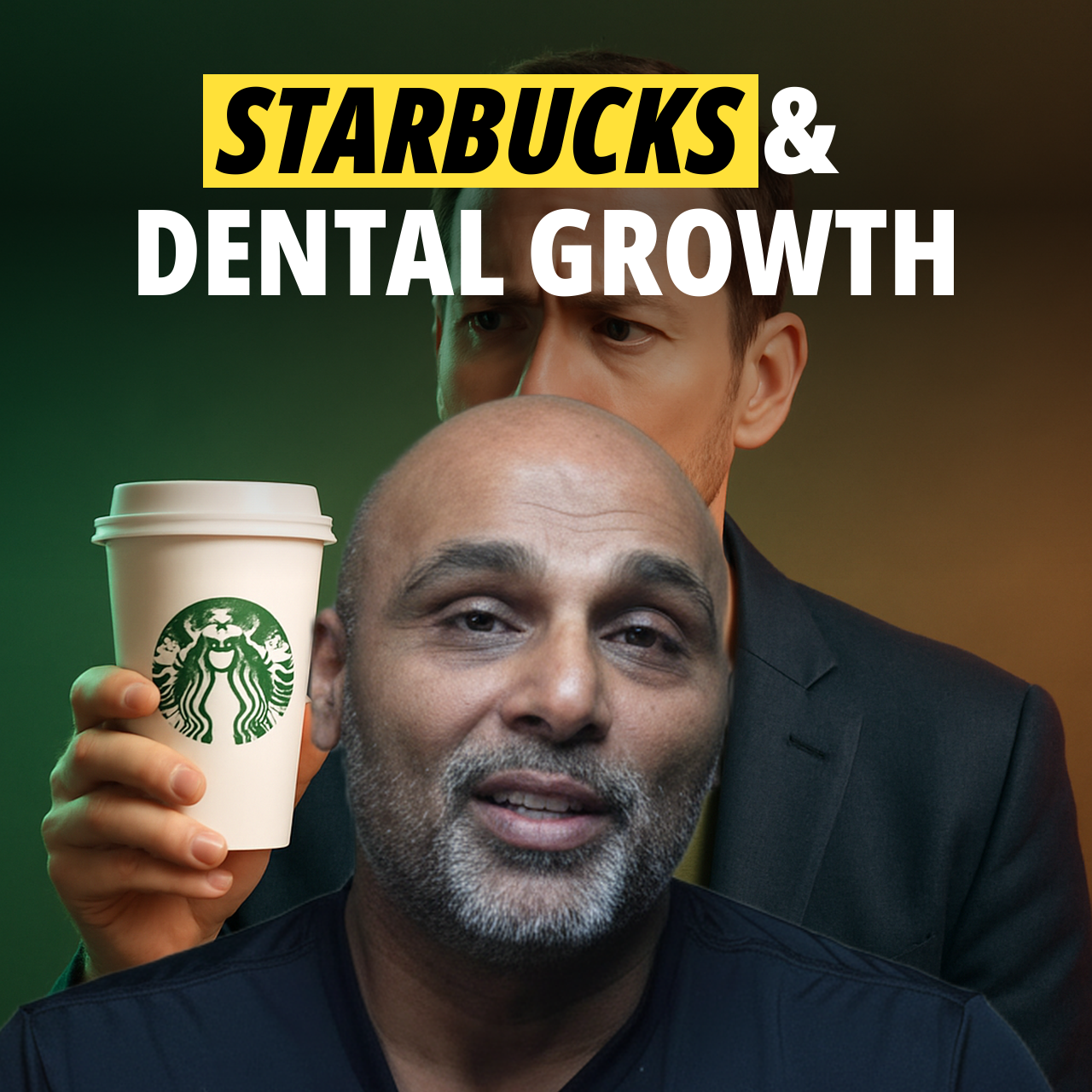
[00:00:00] What does a $37 billion coffee company have to do with your dental practice? A $37 billion company, Starbucks almost didn't make it.
[00:00:11] And the decision that saved them, it's the same one sitting in front of you right now. Let's talk. Why does it feel like no matter how hard you work, your numbers won't budge? You're working harder than you did three years ago.
[00:00:26] And the numbers, the take home is basically the same, maybe a little bit better, maybe a little bit worse, but certainly not for the amount of work that you've done. You've added hours, you've added days, maybe you've added a hygienist, maybe you've added team members, but you still feel stuck.
[00:00:43] You know, that wall from 1.2 to 2 or that wall or that ceiling from 2 to 3, it feels like it's made of concrete.
[00:00:53] You've gotten faster worked on efficiency, you've gotten faster at crowns, you've gotten faster at fillings, you've gotten faster at clicking. You probably even bought a one second curing light. You're more efficient than ever.
[00:01:04] But being faster at the same work isn't a breakthrough.
[00:01:08] It's just a tighter hamster wheel.
[00:01:12] You didn't hit a skill, you didn't hit a ceilings on skills.
[00:01:16] You honestly, you've hit a menu's ceiling.
[00:01:19] So what do crowns, fillings, cleanings and veneers all have in common? From a business standpoint, they feel like variety, but they're all the same revenue category, restorative and preventative. I've been singing this message for nearly 15 years, and it feels like it's the same message over and over again. Different procedures, equals, but with the same business architecture.
[00:01:44] It's like Starbucks selling 47 different kinds of coffees. It feels like that sometimes. Lattes, mochas, cold brew, nitro brew, whatever it is, it's still just coffee. And it only appeals to people who are looking for just coffee.
[00:02:01] So you think you have a diversified practice, but the reality is you don't.
[00:02:05] You have 47 flavors of the same thing. So what are you actually losing by staying where you are?
[00:02:12] You know, the implant patient that you sent down the street, they trusted you and you sent them away.
[00:02:17] Tell me what that says to the patient.
[00:02:20] You didn't survive dental school to do the same five procedures for 30 years. You know, I'm 26 years out of school and I can't imagine still doing the same five procedures that I did my first five years in school. In practice, some of you, you're 10, 15 years in middle of your career, the primary career, and the excitement is gone, you feel burned out. You say you're burned out, but honestly, you're probably not just burned out. You're just feeling kind of flat and bored.
[00:02:51] Some of you are early watching other dentists build something bigger and wondering, when is it my turn?
[00:02:57] Now multiply any of those things by the next 10 years and tell me that's the plan that you envision for yourself. You know, a one product business doesn't just cap your revenue. It caps your growth as a clinician.
[00:03:13] It caps the care you can offer for your patients, and eventually it caps how much you even enjoy showing up.
[00:03:22] So why haven't you expanded yet? You know, nobody wants to be a beginner again. And when you've been an expert or when you're comfortable for 10, 15 years, I totally get it. But that's exactly what Howard Schultz faced at Starbucks. A coffee expert being told to sell sandwiches. And he almost said no, I get why you haven't expanded. But that discomfort that you're feeling. Howard Schultz felt the exact same thing.
[00:03:52] And he almost let it stop him. So what was Starbucks actually up against in 2003? 7,000 stores, no question. The undisputed king of coffee. The best in the world at one thing. You know, that worked until that moment.
[00:04:11] But they were watching customers walk out the door every single morning, not for a better coffee, but for breakfast.
[00:04:21] And they started noticing that McDonald's was eating at their traffic. The was when McDonald's started McCafe. Now McDonald's offered not just coffee. Maybe it was inferior coffee, but at the same time, I could go to McDonald's, get my coffee. Maybe it's good, maybe it's not as good. Hardly tell the difference. Put enough sugar in, it doesn't matter anyway. But now I can get my breakfast, too. Starbucks had a traffic problem disguised as a loyalty problem.
[00:04:50] Customers loved Starbucks Starbucks coffee. But they needed and wanted breakfast. And Starbucks simply didn't have it. They weren't losing tomato coffee. They were losing to a broader menu.
[00:05:04] Does any of this sound familiar? Your patients love you. Your Google reviews are five stars. You're doing everything right, but yet you're still watching. Allowing cases worth thousands of dollars to walk out your door to the specialist down the street. Or worse, to dentists like me down the street.
[00:05:26] And it's not because they're better than you. It's simply because they chose to offer more than you.
[00:05:33] You're not losing patients to better dentists. You're losing cases. To a broader menu. That's exactly where Starbucks was in 2003. Honestly, it's exactly where I was in 2008.
[00:05:45] So what happens when Starbucks finally tested the sandwich in 2003? They tested breakfast sandwiches in selective stores.
[00:05:55] Hated it.
[00:05:56] Bert. He said that the burnt cheese smell was ruining the coffee experience. I can understand, but number one, you shouldn't be burning cheese when you make coffee. But different story.
[00:06:06] But the data was crystal clear.
[00:06:10] Customers are leaving for McDonald's for breakfast every morning.
[00:06:15] He had to choose. Protect the coffee purist's identity or follow where the customer's going.
[00:06:21] He ended up following the data.
[00:06:24] Schultz didn't lose customers to better coffee. He lost them to a broader menu. Does that sound familiar to you?
[00:06:30] Now, let me put this back in dental terms. This is where dental implants come in. Every single month, 1, 2, 3, maybe tens of cases, you're sending them out the door. Over time, those patients are going to find a different dentist who can do it all in one office.
[00:06:48] You may not notice it or feel it at first, but one year, two years, three years down the road, everybody else is passing you and things are standing still or getting worse in your own practice.
[00:07:01] I say this not to be scary, but to share with you where I was in my own practice.
[00:07:07] So what does it look like in a dental practice? Let me show you. I share one with you. The true story dentist I work with. She came to us in 2021 and took our tooth replacement therapy, our beginner implant training. It's where we teach you how to take out teeth, do socket preservation and use guided implant dentistry. To have a safe start at implant dentistry. By 2022, one year after taking the training, she had done $160,000 in implant production. It was 11% of her total production that year.
[00:07:39] Didn't overhaul the practice, didn't change her pace and base. Just added one procedure.
[00:07:46] That's all it takes.
[00:07:47] That's what I cannot get people to understand or emphasize enough.
[00:07:52] And she wasn't some surgical prodigy. She was a general dentist in small town America doing bread and butter dentistry who decided to test one new thing, guided digital. With a team workflow beside her and a community of 3D dentists backing her up, she didn't blow up her practice. She tested the sandwich. The dental implants 160k in her first full year, one new procedure.
[00:08:20] So what's TRT and why is it the sandwich test?
[00:08:24] Tooth replacement therapy is guided digital single implants integrated into your single existing workflow and extraction with grafting same Patients, same building, same team. Just a new category. Not a separate business, not a five year residency. A category addition RT is your sandwich test. Tooth replacement therapy, Guided safe Implant dentistry. Same practice, same team, same patients, new category.
[00:08:51] So what happens when the sandwich works, but you stop there? Starbucks proved that sandwiches sell, so they added sandwiches to all the stores.
[00:08:59] But for years there was just still an add on. Coffee was still 90% of their revenue. They tested the category, but they hadn't committed to it all the way. Sound familiar? For many of you, you're like, hey, I'm already placing implants. I'm doing 2, 3, 4, 5, 7, 8amonth. You've proven the model, but honestly, you're treating it like a side dish. In your practice. You're the dentist doing signals, maybe some grafting, but you haven't built it into a full menu. You proved you can do it. Now the question is whether you'll go all in.
[00:09:35] You tested the sandwich, it worked. But you're still running a coffee shop with a sandwich board out front. What happened to Starbucks when they stopped testing and went all. In 2012, Starbucks acquired La Boulange. Sorry if I said that incorrect. Bakery in Teavana. A $620 million acquisitions.
[00:09:56] They didn't just add sandwich, they, they acquired an entire product category. Now they added teas. Now think about this.
[00:10:05] For those of you that don't love coffee, but love teas, would you ever go to Starbucks back into the early 2000s? No. They were a coffee company.
[00:10:14] So now they added a new complete buyer to come to their store.
[00:10:19] And on top of that, that person can probably get a sandwich too.
[00:10:24] Food is now 20% of Starbucks revenue. 7 billion 7 to $10 billion. And more importantly, it increased their average spend per customer by 25%.
[00:10:38] Now that 20, that 20% of revenue, that 25% average ticket.
[00:10:43] Same stores, same baristas, same locations.
[00:10:47] They just expanded the menu. Said they spent $620 million to do what you can do with a five day training. They expanded the menu.
[00:10:57] So what happened when that dentist I referenced earlier stopped testing and expanded after guided singles proved out, she added sinus grafted and full arch in 2024, in 2022. Remember, she did 160k in implant revenue in 2025. End of this last year, $3 million in implant and surgical revenue. 8x the growth. Same building, same patients, same chair, same bread and butter dentist who stepped out of the comfort zone. Now, of course, there's some business training, there's some team training, there's a community that Goes with it. But it's the same dentist.
[00:11:39] What's even more important, what's hidden in this story is went from 11% of her production to 77% of her production implanted surgical.
[00:11:49] It's not a side dish anymore. It's the main course. She works half the number of days she used to work. That is the beauty. And that's why I'm so passionate about implant dentistry.
[00:12:01] So what does this actually mean for your overhead? You know, think about this. Your rent is paid whether you do an implant or a filling. You, your team is paid whether the chair produces $800 or $3,000.
[00:12:13] Every high value procedure you add is pure leverage on costs you're already paying. Starbucks learned this, figured this out. Food increased tickets by 25% on the same real estate. Your overhead is paid either way. Every implant case you add is pure leverage on costs you're already paying.
[00:12:35] That's not math. That's growth.
[00:12:38] Now, what would have happened if Howard Schultz said no to sandwiches way Back when?
[00:12:44] In 2007, 2008, Starbucks stock dropped 80%. They closed 600 stores. They nearly went under.
[00:12:52] That food revenue that they almost didn't build as part of what kept them alive is what kept them alive. There wasn't a sudden crisis. It was a slow fade that almost became permanent. So what's the dental version of all of this? It's not a dramatic that I'm going to close my store. It's worse. It's the invisible.
[00:13:13] Your practice plateaus. Your overhead creeps. Your margins. Not your clinical margins. Your operating margins shrink.
[00:13:21] You're not failing, you're fading. And every year you wait, that ceiling gets a little loader. You won't close 600 stores. It's worse than that. You'll plateau, and you'll spend the next 10 years wondering why it stopped being fun. I say all of this because I see it month in and month out at 3D dentist. So what's your move? If you haven't started placing implants, tooth replacement therapy at 3D Dentist is your first move. That's the sandwich test. If you're already placing implants and you're ready to go deeper, our advanced sinus and GBR training and full arch express are your next category. Either way, the building is already paid for. If you haven't started, TRT is your first move. Party placing sinus and full arch are your next category. Remember, growth is exponential, and the margins on it are amazing. It's why I love implant dentistry. It's why it's changed my practice, and it's changed my life. And I'd love to do it for you too.
[00:14:24] We train only 100 dentists per year. I work with them side by side. Why don't you be one of those hundred dentists?