Episode Transcript
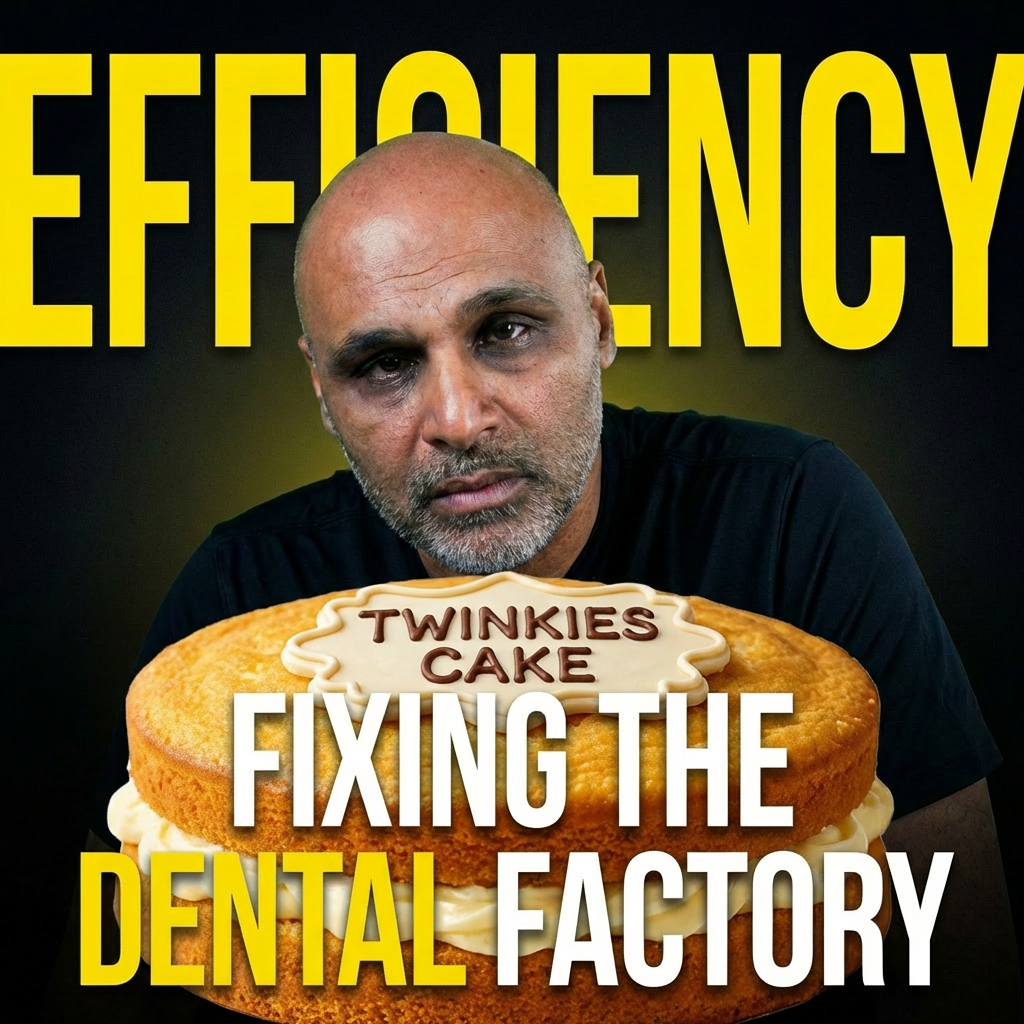
[00:00:00] How many of you remember Twinkies growing up as a kid? How can you not? I mean, they are iconic.
[00:00:08] Honestly, I haven't had one of these in a long time. But what if a two and a half billion dollar company selling the most iconic snack in history went completely broke? That was Hostess Brand 2012 declared bankruptcy. Every factory shut down.
[00:00:27] 18,000 employees, gone.
[00:00:29] Now how does that relate to dentistry? Twinkies, an amazing product that people love. Dentistry, an amazing product that people need now. People were still buying twinkies even after 2012 on eBay. They were selling for a hundred dollars a box. The revenue was massive. Demand was never the problem.
[00:00:48] Sound familiar? To dentistry, demand is really never the problem. Hostess and Twinkies didn't fail because the cake was bad. They failed because the factory was broken. Revenue is vanity, property is sanity, and cash flow is king.
[00:01:06] That's what we're going to talk about this week on Dentistry Made Simple.
[00:01:10] So how does a company doing two and a half billion dollars not seeing company?
[00:01:15] They couldn't change a delivery route, they couldn't update a production line. They couldn't adapt to a single market shift. The machine was locked in place, massive revenues rotting underneath. Revenue wasn't the lie they told themselves every quarter.
[00:01:32] They were doing two and a half billion. We must be fine.
[00:01:35] All of that should sound so familiar in 26. You can't make changes because of team members. You can't update a digital workflow because of God knows what. You can't adapt to any market shifts, to DSOs, to insurances, all of these things. It just seems too daunting.
[00:01:53] You know, the most dangerous ceiling is the one you can't see because revenue is hiding it, you know? So why should a dentist care about a snack cake company other than the fact that Twinkies probably sends us business? Okay, you know, I coach 60 plus practices every single month. The ones that scare me the most aren't the ones doing 6, 7, $800,000. Those guys know that there's a problem.
[00:02:18] It's the ones doing one and a half, $2 million. A full schedule. Can't take a Friday off. The overhead's creeping up. Can't figure out why they're not getting ahead.
[00:02:30] You know, I had one of our docs come to our mastermind in 2021, doing about $800,000. As a practice great clinician, the cake was phenomenal. But the factory, it was broken. He knew it. That's why he came to the Mastermind program. But he didn't really understand why and how to change it.
[00:02:50] You're not failing, you're stuck. And your revenue, it's probably hiding it. So what happens when your own people become the reason you can't change? Hostess had 372 separate union contracts. Couldn't move a baker from one line to another without a grievance. The people who were supposed to help the company grow became the reason it couldn't change. The business was being held hostage by its own workforce. Now, you don't have unions, but you probably have something worse.
[00:03:21] You probably have a team member who controls all the info and gets defensive when you ask questions. Or the assistant or the hygienist who says, that's not my job. I don't do that. You know, the quiet version is you can't change a schedule because Sarah won't like it. That's what you tell your Stop. You can't drop the PPO because your front desk is scared or you're scared of how they'll have conversations.
[00:03:44] You know that dentist, that team was running the show, he couldn't change a system without someone threatening to quit or he believing that someone. If you can't change a system in your business because of a person, you're not the owner of that business. You're the employee.
[00:04:02] So stop asking for permission to run your own business.
[00:04:06] So how did the turnaround team fix 372 union contracts at the Twinkie company?
[00:04:12] They didn't fire everyone. They reset expectations. Day one. This is the new company. Here's how we operate. Your move.
[00:04:21] Run a standards reset stand in front of your team.
[00:04:25] Here's where this practice is going.
[00:04:28] Here are our standards and non negotiables. I'm not asking for a vote.
[00:04:33] The bus is leaving either way. You know, I heard this amazing saying at a seminar I went to.
[00:04:39] Being clear is being kind.
[00:04:42] Clarity isn't cruel. Confusion is. Remember that one?
[00:04:47] What if you're paying 2025 wages to run a 1950s factory? I know we all feel that way.
[00:04:54] Like, oh my God, overhead team costs. They've skyrocketed in 2026.
[00:05:00] But our business model, it's probably a 1980s, 1990s business model, if we're being honest.
[00:05:06] In 2012, Hostess was paying humans to manually load boxes onto trucks.
[00:05:11] Competitors had automated years ago.
[00:05:15] Their overhead, the twinkie overhead, was 40% higher than industry.
[00:05:20] Not because they paid well, but because they refused or unable to modernize. They were a manual factory in an automated world. So where's the 1950s factory in your practice?
[00:05:33] Paying someone $25 an hour to confirm appointments by phone, paper forms, manual insurance, verification, all of these things. That's a sign of a 1990s, 2000s dental practice. That's not creating jobs, that's lighting Profit on Fire.
[00:05:53] 80% overhead isn't inflation, it's inefficiency. Wearing a name tag.
[00:05:59] The same doc I talked about earlier, he was paying three people to do one system that one trained admin could handle. And what I mean by that, sometimes we have multiple people at the front and they all kind of. It's a team thing.
[00:06:13] And when no one's in charge, when nobody owns the outcome, they all point at each other and that becomes inefficient.
[00:06:21] And here's the reality, and I know some of you don't want to hear this, but you need to.
[00:06:26] If software can do it better, faster and cheaper, humans shouldn't be doing it.
[00:06:32] Let that sink in.
[00:06:34] What about the tone? What about what? So what about the turnaround that the new investors got at the Hostess, the Twinkie people?
[00:06:43] What are your three.
[00:06:45] So what three things should you be doing?
[00:06:48] Appointment confirmations. Stop calling, text and automate. I hope all of you, 100% of you, are already doing that. Paper intake forms go digital before they walk in the door. I don't think all of you are doing that. You may have it, but you're not pushing, you're not forcing people, patients to do it. Insurance verification. This is one of the big things. It's what we're working on in our practice. Automated eligibility checks. Not a human on hold. Direct to the insurance company, direct to your software. Those three alone free up 15 to 20 hours a week.
[00:07:24] Then take your people and put them into something more important.
[00:07:30] Experience.
[00:07:31] Here's another one.
[00:07:33] We started doing online appointments in our practice in the beginning. A few a week, now dozens a week. Imagine all that time, a patient's call in, having to answer the phone, having to work through the schedule. All of that gone.
[00:07:49] Patients love it more. Automate. As much of the administration part of your practice.
[00:07:54] Don't automate to get rid of people.
[00:07:57] Automate to liberate the humans, to focus on relationships and patient experience. Your practice will be better for it. So what if your best seller is subsidizing everything that's losing money? Hostess had hundreds of products, Twinkies being the most famous of all of them.
[00:08:14] Most of them were low margin garbage that nobody asked for. Twinkies. The moneymaker had to subsidize all the joke. The best seller is carrying the dead weight, working harder to sell more and making Less on every unit. So what's that in your practice? What's your menu blow the 2 hour molar endo that stresses you out and barely covers the lab bill.
[00:08:37] The PPO write off from it the doc that's doing everything, every procedure, every plan, killing himself or herself, to be quote unquote, comprehensive.
[00:08:45] When we looked at this doc's collections per hour by procedure, he almost fell out of the chair. The procedure that he hung his hat on, the one that he, quote, unquote, loved, that his patients loved and knew him for, was the least profitable procedure in his practice. He your bestseller, the one that you love, it may be subsidizing your losers, and that's exhausting, you know. So what do I suggest you do? I want you to run a procedure inventory. Now, those of you that are in my mastermind and are listening to this, you did this maybe a few years ago. It's time to fine tune your menu. I talk about this all the time on the podcast. Reducing your menu. It's your procedure mix. Here's how we do it. I want you. It's math, so don't get afraid.
[00:09:29] My Asians and Indians will be happy to do the math. Okay, I want you to take your procedures that every procedure, write it down in your practice. Number one, if you write down every procedure that you do and it starts getting more than six or seven, you got a problem. Okay? Number two, how many of those procedures did you do each year? What is your average fee for that procedure? Not what is your fake fee, what is your average actual fee? And then how much time do you actually take to deliver that procedure? On average? Not your worst case, not if everything goes right, your average case. Take all that math and that'll tell you how much you get for that procedure per hour of production.
[00:10:11] Now, what you should see is that some procedures, they give you 2, 3x what your worst procedure does. Now, the ones at the bottom, it's time to refer them out, delegate them, or eliminate them.
[00:10:27] You know, your schedule should be built around your most profitable, most enjoyable work.
[00:10:33] Everything else gets referred, delegated, or eliminated. I know it's hard. I know.
[00:10:39] I know it's hard to let go of it. These people got me here. I need to serve the community. I get it. I'm not telling you you shouldn't. But there's other ways to serve your community than at the expense of your business.
[00:10:52] So what happened to the stock I was talking about in a mastermind that actually did all three of these things? He ran the standards res he drew a line. He said, this is where we're going. Hey, I hope all of you stay, but some of you won't, you know, a couple didn't. But the bus kept moving in the positive direction. He automated things as much as he could in the practice. He freed his people to focus on patients instead of paperwork. He worked on his procedure mix.
[00:11:18] To his credit, he cut out the one procedure that he was known for because he believed and he saw the math. He stopped doing the work that drained his time. What happened to him? His practice in the last 3 years went from 800k to just over $2 million in 3 years. Same dentist. He didn't work 4 times harder. He didn't see 4 times more patients. He changed his clinical skills. He changed his factory.
[00:11:46] He added a provider. He built systems. He worked on team members. He trained up team members. He had to replace some team members. He focused on his schedule around work that built practice, that built the revenue, that built the profits. He stopped baking fresh bread every day where if he didn't show up, the revenue stopped. Now he has a business with a shelf life. Because he's added providers. He can now take more time off. He can focus more on the procedures that he wants to do.
[00:12:15] Stop baking fresh bread every day. Build a business with a shelf life. Your dentistry is like Twinkies. Stop blaming the cake and fix the factory.
[00:12:24] Hostess didn't fix itself. It took a turnaround team. Do you have one? You need people from the outside who can see what you can't, who've been there, who've done it and have helped others do it. You've been inside your own factory so long you can't smell what's burning. That's what the 3D mastermind is. We're your turnaround team. We work with you. We don't do it for you. We work with you. We help you see what you can't. We put you around others who have then been there. We put you around others who are going through what you're doing, fix what you have been tolerating. If you're at a million dollars or more and you know there's a ceiling. If you're at 2 million and you know when you want to get to the next ceiling, there's a link in the description of scheduling a strategy call with Meredith. Our Mastermind program produces results.
[00:13:11] Here's the reality. You don't need more ce. You don't need. You don't need more patience. You need a better factory. Let's build it together.
[00:13:19] Don't wait for something bad to happen to force change.
[00:13:23] Be your own turnaround owner, starting now. Call Meredith. Schedule a strategy call.